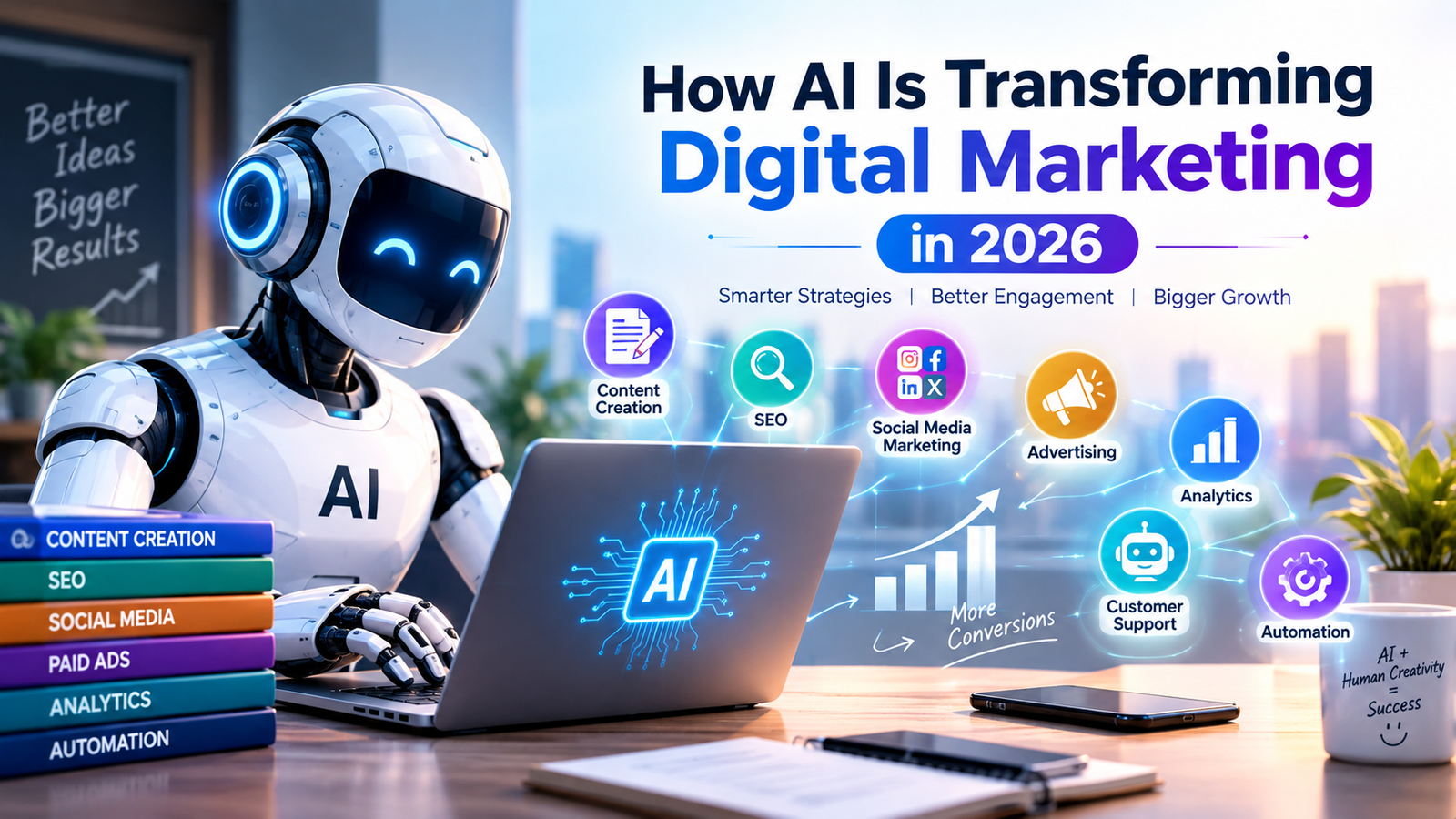
How AI Is Transforming Digital Marketing in 2026
AI in digital marketing 2026 is changing the way businesses approach online marketing. Artificial Intelligence is now an important part of content creation, search engine optimization, advertising, customer engagement, data analysis, and marketing automation.
From small businesses to large companies, marketers are using AI to understand their audiences better, create content faster, personalize customer experiences, and make data-driven decisions.
But how exactly is AI transforming digital marketing in 2026? Let’s explore the major changes and the future of AI-powered marketing.
1. AI-Powered Content Creation
AI has made content creation faster and more efficient. Marketers can use AI tools to generate content ideas, create outlines, write drafts, improve headlines, and adapt content for different platforms.
AI can help marketers save time during the initial stages of content creation. It can also help generate ideas when marketers are looking for new topics or different ways to communicate with their audience.
However, successful content marketing is not simply about producing a large amount of AI-generated content. Businesses still need human creativity, experience, fact-checking, and a clear understanding of their audience.
The best approach in 2026 is to combine AI efficiency with human creativity. AI can help marketers save time, while humans provide originality, strategy, emotion, and brand identity.
2. AI and Search Engine Optimization (SEO)
AI is also changing the way businesses approach SEO. Modern marketing teams can use AI to analyze keywords, understand search intent, identify content opportunities, optimize existing articles, and organize large amounts of information.
Search is becoming increasingly conversational. People often ask complete questions instead of searching only for short keywords. This means businesses need to create useful, well-structured content that directly answers what people are looking for.
In 2026, SEO is becoming less about simply repeating keywords and more about creating helpful, trustworthy, and relevant content for real users.
AI can support SEO professionals by helping them research topics, understand search patterns, identify content gaps, and improve the structure of their articles.
3. Personalized Customer Experiences
One of the biggest advantages of AI in digital marketing is personalization.
AI can analyze customer behavior, interests, previous interactions, and preferences to help businesses deliver more relevant marketing messages.
For example, an online store can recommend products based on what a customer has previously viewed or purchased. Similarly, an email marketing campaign can provide different messages to different customer groups.
Personalization can make marketing communication more relevant and help businesses build stronger relationships with their customers.
Instead of sending exactly the same message to everyone, businesses can use data and AI-assisted systems to create experiences that are more relevant to individual users.
4. AI in Social Media Marketing
Social media marketers are also benefiting from AI. AI tools can help with content ideas, captions, audience research, scheduling, trend analysis, and performance reporting.
Instead of spending hours analyzing large amounts of social media data manually, marketers can use AI to identify patterns and opportunities more quickly.
AI can also help marketers repurpose content. For example, a long-form article can be converted into ideas for social media posts, short-form content, or email campaigns.
However, social media still depends heavily on authenticity. Brands should use AI as a supporting tool rather than allowing automation to replace genuine communication with their audience.
Human creativity and understanding of the brand remain important for building trust and meaningful relationships on social media.
5. AI-Powered Advertising
Digital advertising is another area where AI is making a major difference.
AI can help marketers analyze campaign performance, identify audiences, test different creative approaches, and optimize advertising strategies.
AI-powered systems can process large amounts of data much faster than humans. This allows marketers to make quicker decisions and potentially improve the efficiency of their campaigns.
For businesses, this can mean better use of advertising budgets and more data-driven marketing decisions.
AI can also assist marketers in understanding which audiences are responding to particular campaigns and which areas may need improvement.
6. AI Chatbots and Customer Support
AI-powered chatbots are becoming an important part of customer communication.
Businesses can use chatbots to answer common questions, provide basic information, guide visitors, and support customers outside normal business hours.
For example, a website visitor may want to know about a service, business timing, pricing information, or the next step in an enquiry. An AI-powered chatbot can provide an immediate response to many routine questions.
This can improve response times while allowing human employees to focus on more complex customer needs.
The most effective approach is to combine AI assistance with human support when a conversation requires understanding, judgment, or personal attention.
7. AI and Marketing Analytics
Digital marketing generates a huge amount of data. AI can help marketers understand this information and identify useful patterns.
Businesses can use AI-assisted analytics to study website traffic, customer behavior, campaign performance, conversions, and other marketing metrics.
Instead of looking only at what happened in the past, marketers can use data and AI-based analysis to identify trends and make better-informed decisions about future campaigns.
This can help marketing teams spend more time on strategy and less time manually processing large amounts of information.
8. Marketing Automation with AI
AI is making marketing automation more intelligent.
Businesses can automate repetitive tasks such as email campaigns, customer segmentation, lead follow-ups, reporting, and content workflows.
The major benefit is not simply automation itself. AI can help make automated marketing more responsive to customer behavior.
For example, different customers can receive different messages depending on their interests or previous interactions.
This allows businesses to create marketing workflows that can respond more effectively to customer activity while reducing repetitive manual work.
9. AI for Small Businesses
AI is not only useful for large companies. Small businesses can also use AI to improve their digital marketing activities.
A small business may use AI to generate content ideas, plan social media posts, analyze marketing data, create email drafts, research topics, or improve customer communication.
This can help small teams save time and compete more effectively in an increasingly digital marketplace.
However, businesses should choose AI tools based on their actual needs rather than using AI simply because it is a trend.
10. Benefits of AI in Digital Marketing
AI can provide several benefits to digital marketing teams.
- Faster content creation
- Better audience understanding
- More personalized marketing
- Improved marketing automation
- Faster data analysis
- More efficient advertising campaigns
- Better customer support
- Improved decision-making
- Time savings for marketing teams
- Ability to handle large amounts of marketing data
- Faster research and content planning
- More efficient marketing workflows
When used correctly, AI can help marketers focus more on strategy, creativity, and customer relationships.
11. Challenges of Using AI in Digital Marketing
Despite its benefits, AI also creates challenges for digital marketers.
AI-generated information can sometimes be inaccurate, so human review and fact-checking remain important. Businesses also need to protect customer data and use AI responsibly.
Another challenge is maintaining originality. If every business produces similar AI-generated content, it can become difficult for brands to stand out.
There is also a risk of relying too heavily on automation. Marketing is ultimately about people, and customers still value authentic communication and genuine experiences.
For this reason, marketers should focus on combining AI technology with human creativity, expertise, and authentic communication.
12. AI and the Changing Role of Digital Marketers
AI is changing the role of digital marketers rather than simply eliminating the need for marketers.
Instead of spending most of their time on repetitive tasks, marketers can use AI to assist with research, content planning, data analysis, and automation.
This gives marketers more time to focus on important areas such as strategy, creative thinking, brand building, customer relationships, and business growth.
As AI becomes more common, understanding how to use AI effectively may become an important skill for digital marketing professionals.
13. The Future of AI in Digital Marketing
AI will continue to influence digital marketing as the technology develops.
Marketing teams are likely to use AI more deeply for research, content workflows, customer experiences, analytics, advertising, and automation.
However, the future of digital marketing will not simply be about AI replacing every marketer. Instead, successful marketers will learn how to work effectively with AI.
The marketers who understand both technology and human behavior will be in a strong position to create better strategies, better customer experiences, and more useful content.
Businesses that adopt AI thoughtfully while maintaining human creativity and trust can potentially gain an advantage in the competitive digital marketplace.
Conclusion
AI is transforming digital marketing in 2026 by making marketing faster, more personalized, data-driven, and automated.
From content creation and SEO to social media, advertising, analytics, and customer support, AI is becoming a powerful tool for modern marketers.
But technology alone does not guarantee successful marketing. Businesses still need creativity, strategy, trust, and a strong understanding of their customers.
The future belongs to marketers who can combine the power of AI with human creativity and authentic communication.
Frequently Asked Questions (FAQs)
What is AI in digital marketing?
AI in digital marketing means using artificial intelligence technologies to assist with activities such as content creation, SEO, advertising, customer support, personalization, analytics, and marketing automation.
How is AI changing digital marketing in 2026?
AI is helping marketers automate repetitive tasks, analyze large amounts of data, personalize customer experiences, improve content workflows, support SEO, and make faster data-driven decisions.
Can AI replace digital marketers?
AI can automate many repetitive marketing tasks, but it does not completely replace the need for human marketers. Strategy, creativity, communication, judgment, and understanding customers remain important.
Is AI useful for small businesses?
Yes. Small businesses can use AI to support content creation, social media planning, customer communication, research, analytics, and other marketing activities.
Is AI-generated content good for SEO?
AI can assist with content creation, but content should be useful, accurate, original, and created to genuinely help the audience. Human review and editing are important.
What is the future of AI in digital marketing?
AI is likely to become increasingly integrated into content creation, SEO, advertising, personalization, analytics, customer service, and marketing automation.
Final Thoughts
AI is not just another digital marketing trend. It is becoming an important part of how modern businesses plan, create, analyze, and improve their marketing activities.
The key is not to choose between AI and humans. The strongest marketing strategies can combine AI’s speed and analytical capabilities with human creativity, experience, and understanding.
For digital marketers in 2026, learning how to use AI responsibly and effectively can be an important step toward building smarter and more efficient marketing strategies.
Leave a Reply