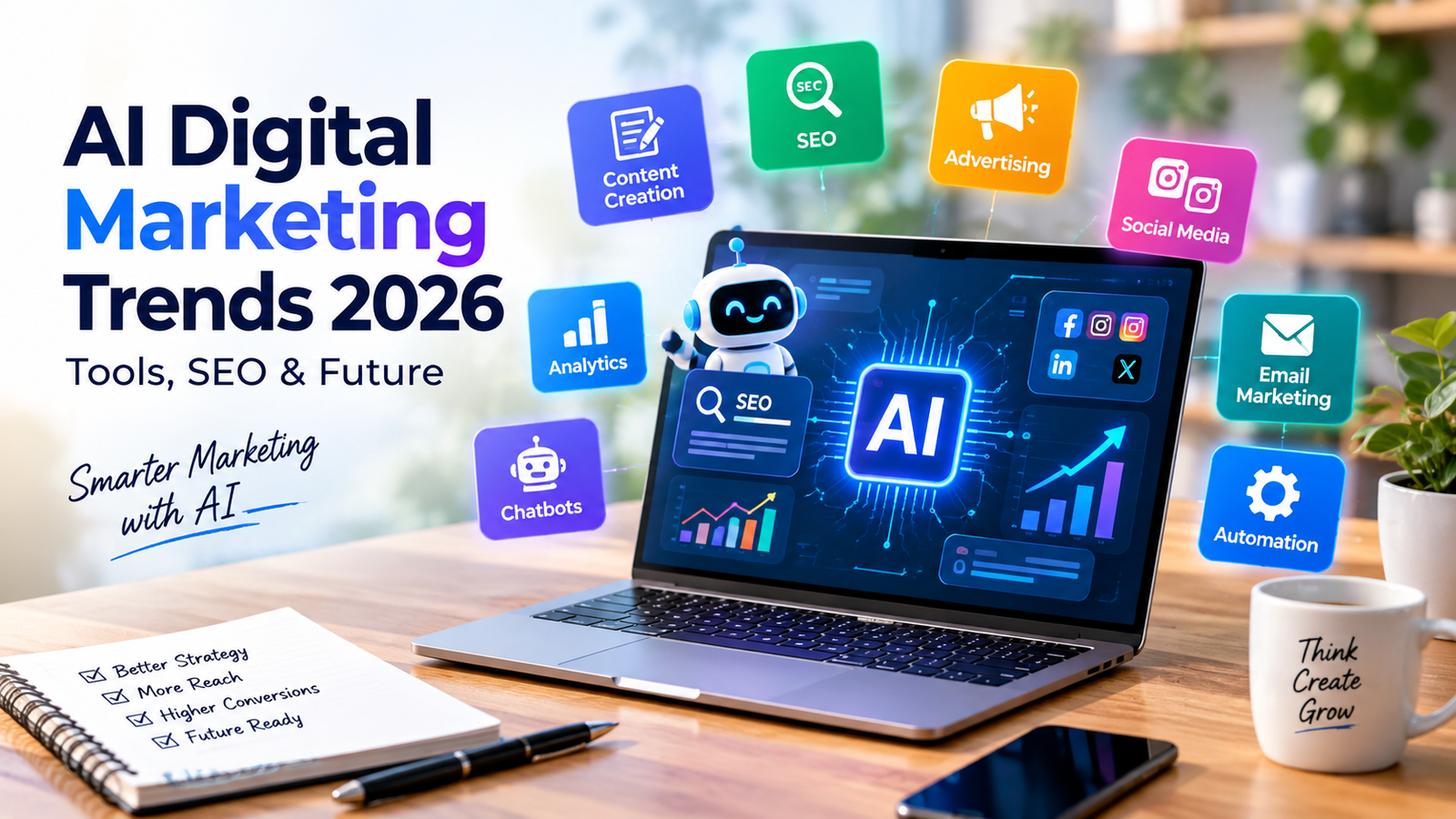
Artificial Intelligence (AI) is changing the way businesses approach digital marketing. From creating content and analyzing customer behavior to improving SEO and automating repetitive tasks, AI has become an important part of modern marketing strategies.
In 2026, businesses of all sizes can use AI-powered tools to work more efficiently, understand their audiences better and create more personalized digital experiences.
But AI is not simply about replacing traditional marketing. The real opportunity is to combine AI technology with human creativity, strategy and decision-making.
In this article, we will explore how AI is changing digital marketing in 2026, the major trends marketers should know about, and how businesses can use AI effectively.
What Is AI in Digital Marketing?
AI in digital marketing means using artificial intelligence technologies to analyze information, automate tasks, understand audiences and support marketing decisions.
AI can process large amounts of data much faster than humans. This allows marketers to identify patterns, generate ideas, personalize campaigns and improve their overall marketing workflow.
Some common applications of AI in digital marketing include:
- Content creation
- Search engine optimization
- Customer behavior analysis
- Social media marketing
- Email marketing
- Advertising optimization
- Chatbots and customer support
- Data analysis
- Marketing automation
1. AI Is Making Content Creation Faster
Content is one of the most important parts of digital marketing. Businesses need blog posts, social media content, advertisements, product descriptions, videos and other forms of communication.
AI tools can help marketers generate ideas, create outlines, improve writing and develop content concepts much faster.
However, AI-generated content should not simply be published without review. Human editing, fact-checking, originality and brand voice remain important.
A useful approach is to treat AI as a creative assistant rather than a complete replacement for the marketer.
2. AI Is Changing SEO
Search Engine Optimization is also being influenced by artificial intelligence.
AI can help marketers with tasks such as:
- Keyword research
- Content ideas
- Search intent analysis
- Content optimization
- Competitor research
- Website audits
- Meta title and description ideas
Search engines are also becoming better at understanding the meaning and context of content.
This means websites should focus on creating genuinely useful content instead of simply repeating keywords.
For example, instead of creating an article only to target the keyword “digital marketing,” a website should provide practical information that actually helps people understand digital marketing.
3. Personalized Marketing Is Becoming More Powerful
Different customers have different interests and needs.
AI can analyze customer interactions and help businesses deliver more personalized experiences.
For example, an online store can use customer behavior to recommend relevant products. A marketing platform can also help businesses determine which type of content may be more relevant to different audience segments.
Personalization can make digital marketing more relevant because customers are more likely to engage with content that matches their interests.
4. AI Is Improving Social Media Marketing
Social media requires consistent content and regular audience engagement.
AI can assist marketers with:
- Content ideas
- Caption writing
- Hashtag research
- Content scheduling
- Audience analysis
- Performance analysis
- Creative concepts
AI can also help businesses identify patterns in engagement data.
However, successful social media marketing still requires authentic communication. Human creativity and understanding of the audience remain important.
5. AI Is Transforming Digital Advertising
Digital advertising platforms already use machine learning and automation to optimize campaigns.
AI can help marketers analyze campaign performance and identify opportunities for improvement.
It can assist with:
- Audience segmentation
- Ad creative ideas
- Campaign analysis
- Conversion tracking
- Budget optimization
- Performance predictions
Instead of manually analyzing every piece of campaign data, marketers can use AI-powered systems to identify useful patterns and focus their time on strategy.
6. AI Chatbots Are Improving Customer Communication
Businesses receive questions from customers every day.
AI-powered chatbots can help answer common questions, provide basic information and guide visitors toward relevant pages or services.
For example, a website chatbot could answer questions about:
- Services
- Opening hours
- Product information
- Basic pricing information
- Contact details
- Frequently asked questions
For more complex issues, customers should still have access to human support.
7. AI Can Help Analyze Marketing Data
Digital marketing produces a huge amount of data.
Businesses can track website visitors, clicks, conversions, engagement, advertising performance and many other metrics.
AI can help marketers identify patterns in this data and turn large amounts of information into useful insights.
This can help answer questions such as:
- Which content is performing well?
- Which audience is engaging the most?
- Which campaigns are generating results?
- Where are visitors leaving the website?
- Which marketing activities need improvement?
Data becomes much more useful when marketers can turn it into practical decisions.
8. Video Marketing and AI
Video has become an important part of digital marketing.
AI-powered tools can assist with various parts of video production, including:
- Video ideas
- Scripts
- Captions
- Subtitles
- Voice generation
- Editing assistance
- Short-form video creation
This can make video production more accessible to small businesses and individual creators.
However, the quality of the idea, storytelling and communication still matter more than simply using AI.
9. AI and Marketing Automation
Marketing automation allows businesses to perform repetitive tasks with less manual effort.
AI can support automated workflows such as:
- A visitor submits a form.
- The system records the enquiry.
- A confirmation message is sent.
- The lead is added to a database.
- Follow-up communication is scheduled.
Automation can save time and allow marketers to focus more on creative and strategic work.
10. What Skills Will Digital Marketers Need in the AI Era?
As AI becomes more common, digital marketers will need a combination of technical and creative skills.
Important skills include:
AI Literacy
Marketers should understand what AI tools can and cannot do.
SEO
Understanding search intent, content quality and website optimization remains important.
Content Creation
Strong writing, storytelling and communication skills continue to matter.
Data Analysis
Marketers should be able to understand performance data and use it to make informed decisions.
Creativity
AI can generate ideas, but human creativity is still essential for developing unique campaigns and brand identities.
Critical Thinking
AI-generated information should be reviewed and verified before being used.
Benefits of Using AI in Digital Marketing
When used properly, AI can provide several benefits.
Saves Time
AI can automate repetitive tasks and speed up content and research workflows.
Improves Efficiency
Marketers can process information faster and focus on higher-value activities.
Supports Personalization
AI can help businesses create experiences that are more relevant to different audiences.
Helps With Data Analysis
Large amounts of marketing data can be analyzed more efficiently.
Supports Small Businesses
AI tools can help individuals and small businesses access capabilities that previously required larger teams.
Challenges of AI in Digital Marketing
AI also comes with challenges.
Accuracy
AI-generated information can sometimes contain mistakes, so important information should be checked.
Originality
Simply publishing AI-generated content without adding original value can result in generic content.
Privacy
Businesses need to handle customer information responsibly and follow applicable privacy requirements.
Overdependence
Using AI for every marketing decision can reduce creativity and human judgment.
The best approach is to use AI as a tool while keeping people responsible for important decisions.
The Future of AI in Digital Marketing
AI will likely continue to become more integrated into digital marketing.
Future marketing workflows may involve greater automation, more personalized customer experiences, smarter data analysis and increasingly advanced creative tools.
But technology alone will not create a successful marketing strategy.
Businesses will still need:
- Strong branding
- Useful content
- Customer understanding
- Creativity
- Trust
- Good communication
- Clear marketing goals
The marketers who learn how to combine AI with these human skills can adapt more effectively to the changing digital environment.
Final Thoughts
AI is changing digital marketing in 2026 by making many marketing tasks faster, more automated and data-driven.
From SEO and content creation to advertising, social media, customer communication and analytics, AI is becoming a valuable part of the modern marketer’s toolkit.
However, successful digital marketing is not simply about using the newest AI tool. It is about using technology intelligently while maintaining creativity, accuracy, originality and a strong understanding of the audience.
AI can provide the tools, but people provide the strategy, creativity and direction.
If you are a student, freelancer, creator or business owner, learning how AI works alongside digital marketing can be a valuable skill for the future.
Leave a Reply